
The Cloud Has a Postcode: Why Data Centres Must Earn Their Social Licence
I spend my working life around rolling out technology programmes: warehouses, pipelines, dashboards, and the portfolio decisions that decide which of them get built. In that world, “the cloud” is an abstraction. We provision capacity with a few clicks. We schedule jobs to run hourly because it costs us nothing to do so. We keep years of raw data “just in case”. And we now place AI assistants into workflows that once needed a spreadsheet and ten minutes of thought.
None of that is free. It is just paid for somewhere else.
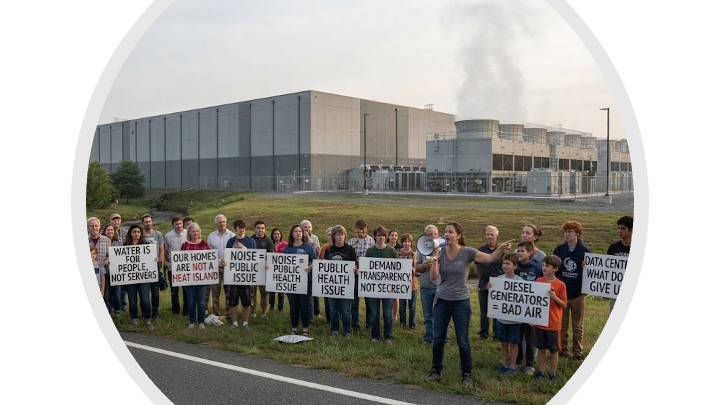
This week, a planned AI data centre at Cooks River in Sydney was scrapped. Local campaigners called it “a victory for people power”. It was not an isolated event. Other Sydney proposals, at Lane Cove and Guildford, have also been withdrawn in recent months. In Melbourne, community and council opposition has stalled power upgrades at one of the country’s flagship facilities.
Across the Pacific, the pattern is larger and louder. Time reported that in the first quarter of 2026 alone, 75 major US data centre projects worth more than $130 billion were delayed or cancelled, in part because of organised local opposition. NPR estimates that around 500 local moratoriums are now in place. Data centres became a campaign issue in the midterms, with candidates from both parties running ads against them.
It would be easy to read this as a familiar story about people who want the benefits of technology but object to its infrastructure. I think that reading is wrong, and costly. What we are seeing is not hostility to AI. It is a community asking an ordinary question that technology companies have been slow to answer: what do we get, and what do we give up, when this arrives on our doorstep?
The convenience we don’t see
Every query, model call and retained table ends up as electricity drawn from a regional grid, as water evaporated through cooling towers, as diesel generators tested on a Tuesday morning, and as low-frequency hum heard by the families who live closest. The cloud has a postcode. The people at that postcode are increasingly asking why they carry the costs of convenience enjoyed by everyone else.
What communities are actually worried about
When you read past the headlines, the objections are specific and, for the most part, reasonable. They are also, at heart, public health concerns.
Water. Large facilities can use up to 5 million gallons of water a day, according to Time’s reporting. Sydney Water has warned that data centres could account for up to a quarter of the city’s drinking water by 2035. In rural parts of the US, some residents say nearby developments have affected their wells. Operators dispute some of these claims, but in a warming climate, any competition for drinking water touches a nerve.
Energy bills. A connection request of hundreds of megawatts reshapes a regional grid. Households fear, with some justification, that the cost of new generation and transmission lands on their bills. In a cost-of-living crisis, that is not an abstract worry; energy poverty is itself a health risk.
Air quality. Data centres keep large fleets of diesel backup generators. A Virginia Commonwealth University study of 138 facilities in Northern Virginia found generator emissions rose sharply between 2018 and 2023, with some clusters now emitting more than a nearby power plant. Researchers at UC Riverside and Caltech have projected that air pollution linked to US data centres could contribute to as many as 1,300 premature deaths a year by 2030. These are models, not counts, and their assumptions are debated. But they are the kind of evidence that would trigger a health impact assessment for almost any other industrial facility.
Noise, heat and land. Constant cooling noise, the loss of greenfield sites, and the cumulative strain on local roads and substations rarely appear in glossy investment announcements. They appear in every planning objection.
The polling reflects this. A Reuters poll cited by Time found that only 14% of Americans would be comfortable with a data centre being built near them. That is not a fringe position. It is a consensus.
From planning permission to social licence
Mining companies learned, often painfully, that a legal permit is not the same as consent. The phrase they adopted was social licence to operate: the ongoing acceptance of a project by the people who live with it. You cannot buy it once. You earn it continually, through transparency, fairness and tangible local benefit.
Data centres now face the same test. A New South Wales parliamentary inquiry found that existing planning processes were failing to account for the cumulative demands data centres place on electricity networks, water supplies and other infrastructure. The planning system was designed to judge one building at a time. It was never designed for a technology whose footprint grows with every new model release.
So what would a genuine social licence look like? I would suggest five tests:
- Metered transparency. Publish actual, independently verified water and energy use per site, not corporate averages or annual sustainability PDFs. If we can monitor a pipeline to the second, we can report a facility’s water draw monthly.
- Health impact assessment as standard. Treat generator emissions, noise and heat as public health questions, assessed before approval and monitored afterwards, with results shared openly.
- Cumulative planning. Judge each proposal against the combined load on the local grid, water catchment and community, not in isolation.
- Shared value that people can feel. Waste heat for district heating, funding for grid and water upgrades, local skills and jobs that last beyond construction. Not a one-off community fund announced at the press conference.
- Demand discipline. Recognise that the cleanest megawatt is the one never consumed. Efficiency is not only the operator’s job; it belongs to everyone who generates the demand.
Lessons for the UK
The UK is about to find out whether it has learned from the US and Australia. The government’s AI Growth Zones are designed to speed up the building of large-scale compute. Water is listed as a site requirement, but Water UK told Parliament in July that data centres are excluded from the Environment Agency’s national water resources framework and that Growth Zone policy does not address water at all.
The numbers are still modest but rising. Data centres in England use around 6.6 million litres of drinking water a day, according to Water UK, a figure it expects could reach almost 20 million if capacity triples by 2030 as planned. In Slough, already one of Europe’s densest data centre clusters, Affinity Water has warned that some proposals have requested up to 3 million litres a day. There have even been reports that data centres could be given priority supply during droughts and hosepipe bans. Few things would destroy public trust faster.
The UK has an advantage: it can see the backlash coming. Building the five tests above into Growth Zone criteria now, while there is still goodwill, would be far cheaper than reacting to moratoriums later. Scotland is already reported to be considering one.
Our part in this, as technology leaders
It is tempting for those of us who build data products to treat this as someone else’s problem, belonging to hyperscalers, planners and politicians. I would argue we are closer to it than we think. We are the source of the demand.
Some practical questions worth asking in your next programme review:
- Do we need this refresh rate? A dashboard rebuilt every 15 minutes that is read twice a day is pure waste.
- What are we keeping, and why? Retention policies are a governance issue, a cost issue and a sustainability issue. Data minimisation serves all three.
- Is AI the right tool here? A large model is a remarkable instrument. It is also an energy-intensive way to do a task a well-written SQL query could handle.
- Can we measure it? Most cloud platforms now expose carbon and energy estimates. Add them to the same scorecards we use for cost and performance. What gets measured gets managed.
- Where and when do we run it? Carbon-aware scheduling and region choice can cut the footprint of batch workloads with no loss of value.
None of this will stop a single data centre being built. But it changes the conversation, from “growth at any cost” to “growth we can justify”. And when our organisations can show that they use compute with care, they earn a little of that social licence themselves.
A closing thought
Data centres are now civic infrastructure, as essential to modern life as power stations, reservoirs and hospitals. We accept those things in our communities because, over time, we built the rules, the transparency and the sense of fairness that make them acceptable.
The backlash in Sydney, Virginia and Maryland is not the end of the AI story. It is a sign that the story has moved from the boardroom to the high street. The industry that learns to listen there, and to count what it consumes as carefully as it counts what it earns, will be the one that keeps building.
How is your organisation thinking about the footprint of its data and AI workloads? I would genuinely like to hear: what is measured, what is not, and what is changing.
Sources
- ABC News: Controversial Sydney AI data centre at Cooks River scrapped following community backlash (8 Nov 2026)
- ABC News: Can Labor cash in on AI and data centres without paying the US political price? (8 Nov 2026)
- ABC News: The bigger, hungrier AI data centres set to escape looming water and power restrictions (11 Sep 2026)
- SCMP: Data centre opposition is growing in Australia. Is there a middle ground?
- Time: Community Backlash to AI Data Centers Is Growing Across the U.S. (22 Jul 2026)
- NPR: An unexpected activist emerged to help block a $5 billion data center in Maryland (7 Nov 2026)
- Brookings: Why data centers are a top issue in the 2026 midterms
- CNBC: How U.S. data center backlash is spreading across Europe and Asia (3 Oct 2026)
- VCU: Northern Virginia data center air pollution rivals power plant emissions
- Building Design + Construction: Emissions for power to run AI data centers will cause serious health problems (UC Riverside / Caltech research)
- The Register: Britain isn’t considering datacenters’ thirst for water in its ‘AI superpower’ ambitions (23 Jul 2026)
- TechRadar: UK AI data centers could be given water priority during heatwaves and hosepipe bans
- Envirotec: Water planning ‘out of step’ with Government growth agenda, warns Water UK (21 Jul 2026)