
Robots Everywhere: Three Quiet Stories from the Same Week
Amazon has just crossed a million robots in its warehouses. The US Army has activated its first unit of soldiers whose full-time job is adapting robots for the field. And in Ukraine, engineers are 3D-printing airless tyres so ground drones can keep running after being shot. Robotics is no longer one story. Right now, it is three, happening in parallel.

Commercial: from factory floor to front garden
The clearest signal that robots have arrived at scale is a number. Amazon has officially surpassed a fleet of one million robots working alongside its 1.5 million human employees, including mechanical arms, Roomba-like floor loaders and pallet-sorting machines. That is no longer a pilot programme. It is an industrial reality.
literally boxing humans out of workspaces
Brad Greenwood, Business professor at George Mason University
The interesting question is what those machines are doing to the people next to them. Brad Greenwood, a business professor at George Mason University, said warehouse robots are not just helping Amazon cut labour costs but are, in his phrase, “literally boxing humans out of workspaces”. Warehouse robotics is unusual because, unlike most twentieth-century automation, it happens in the same aisle as the picker. Joan Moriarty of the Strategic Organizing Center put it more bluntly: Amazon’s robots get the headlines because the company “doesn’t want to talk about the tens of thousands of Amazon workers who are injured every year” by its speed-at-any-cost culture.
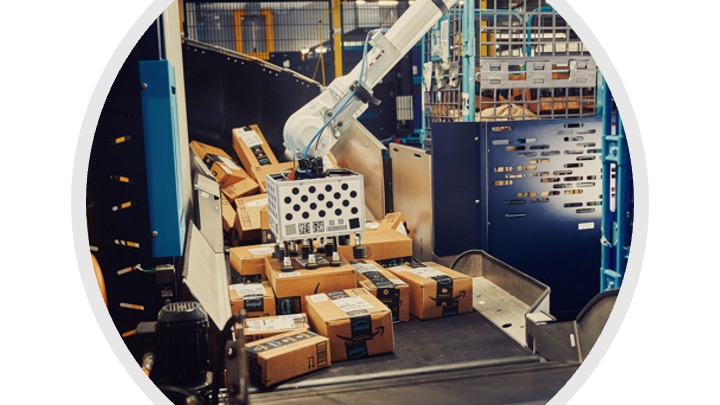
Beyond the warehouse, the next commercial layer is taking shape. Agility Robotics’ Digit 5 humanoid is being marketed for twenty-hour workdays with nine-minute charging. Promise Robotics has signed a multi-year deal with US homebuilder DR Horton for on-site construction robotics. India installed nearly 10,500 industrial robots in 2025, up 15% on the year before, according to the International Federation of Robotics, making it the world’s sixth-largest market even as Japan, South Korea and Germany saw declines.
The layer that touches the rest of us is more contested. SoftBank is in talks to acquire the US security group Allied Universal in a deal reported at $18–30 billion, with founder Masayoshi Son framing robotics as central to security services. Pudu Robotics’ machines are running hotel operations in Shenzhen. In Chicago, two customers have filed class-action lawsuits against Coco Robotics and Serve Robotics, alleging the companies scanned their faces and hands without consent during deliveries. In Philadelphia, a retired University of Pennsylvania professor was arrested for repeatedly blocking an Uber Eats delivery robot in protest at worker displacement. The commercial story is no longer just about whether robots work. It is about where they are allowed to go, what they are allowed to see, and what happens to the people whose jobs they take or reshape.
Military: a new kind of soldier, and a new kind of tyre
The military side has its own quiet shift. On 2 October 2026, ten US Army warrant officers became the Army’s first “robotics technicians” under a new 390A military occupational speciality, a permanent career path rather than a pilot. Major General Jason Slider, who commands the US Army John F. Kennedy Special Warfare Center and School at Fort Bragg, drew a careful line: “We’re not building a pilot. What we’re building is a soldier that can adapt a piece of robotic kit to the mission, to the enemy, to the terrain.” Militaries that “solely focus on pilots quickly lose the advantage to an adversary or an enemy force that can adapt that piece of tech to the mission,” he said, pointing to the lessons of Ukraine and Nagorno-Karabakh.
We’re not building a pilot. What we’re building is a soldier that can adapt a piece of robotic kit to the mission, to the enemy, to the terrain.
Major General Jason Slider
In the first phase of the 390A course, students built a mesh-network system that kept drones communicating when individual nodes were being jammed. Chief Warrant Officer 5 Michael Updike, one of the architects of the programme, said the exercise showed how a $1,000 HD camera bolted to a quadcopter could keep working through jamming by routing around lost nodes.
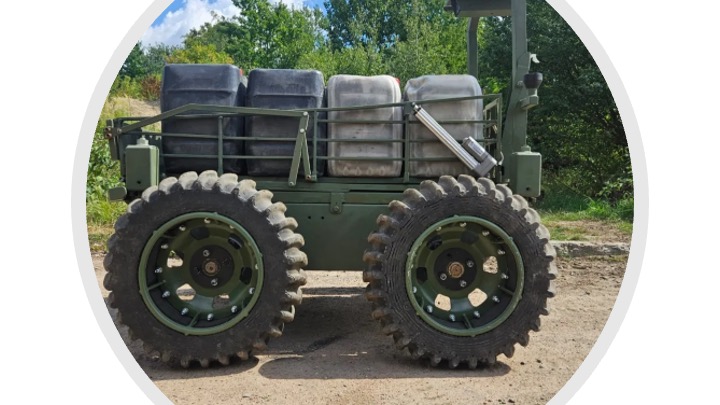
In Ukraine, the innovation looks less like a programme and more like a supply chain. Engineers at Print&Live UA and iSCALE 3D have developed 3D-printed airless tyres for unmanned ground vehicles, built around a lightweight internal lattice that keeps working after being shot or punctured. The two-piece rim lets soldiers swap a damaged tyre with simple hand tools in the field, and the companies are already shipping them to the front line. As one of the engineers explained to Popular Science: “The most important mission of a UGV is not spectacular — it is bringing a wounded person back, or water, medicine and supplies forward… One puncture and the mission ends where the machine stops.” Ukraine’s wartime tech sector has grown from a handful of defence companies before the invasion to hundreds today, with Kyiv now dubbed “Mil-Tech Valley”.
Wider signals from the same window include Russia’s use of jet-powered drones against Ukrainian infrastructure, Ukrainian drone strikes reaching Russian energy targets in Siberia, Israel’s procurement of twelve Apache gunships, and North Korea’s claim that it has tested a new torpedo system with AI capabilities. Militaries and arms-control advocates continue to debate where the line should sit between remote-controlled and autonomous targeting, with no international consensus yet on the answer.
Emergency response: robots where humans struggle to reach
Much of the most visible emergency-response robotics is still in the lab, but the direction is clear. The same Ukrainian airless-tyre technology is being adapted for search-and-rescue and logistics UGVs in disaster zones, where debris and rough terrain would cripple conventional tyres. The two-piece rim, designed for “battlefield areas where full workshops aren’t available”, works just as well when the workshop is a collapsed building rather than a trench.
Researchers have unveiled an “albatross robot” that can airdrop into remote waters via a morphing wing-sail, a “wound-helix” robot that can leap and bound over obstacles, and EmArm, an embodied robotic arm with human-like touch sensing. Japan is deploying robots and pepper-spraying drones to tackle bears encroaching into towns. MassRobotics has opened applications for a Healthcare Robotics Startup Catalyst Programme, and Hesai has unveiled Kosmo, a robot that turns real places into 3D environments for embodied-AI training — the step before any rescue robot can navigate a burning building it has never seen.
What connects these three stories
Look across commercial, military and emergency-response robotics and a few common themes appear.
The first is AI integration. The Digit 5 humanoid, the 390A mesh-network training exercise, and Hesai’s 3D mapping all point to robotics shifting from mechanical engineering into something closer to software. A former Nvidia robotics leader told Benzinga and TechCrunch on 17 October 2026 that “robotics still awaits its ChatGPT moment” and remains stuck in disconnected component work. Whether or not one agrees with that framing, the direction of travel is the same.
The second is cost. A $1,000 HD camera bolted to a quadcopter by US Army students, and 3D-printed Ukrainian tyres that need no factory, are both stories about doing more for less, and doing it in the field rather than waiting for a depot.
The third is workforce impact. Amazon’s million robots stand alongside its 1.5 million human workers. The Philadelphia arrest and Chicago lawsuits show what happens when commercial robotics meets the public in a way that people find intrusive or threatening.
I think it’s my First Amendment right to publicly demonstrate on a sidewalk to protest against delivery robots…corporations that displace human delivery workers in order to enrich their own bottom line.
Carolyn Marvin, 78, University of Pennsylvania professor emeritus protest against delivery robots in Philadelphia
The fourth is trust and safety. Greenwood’s “boxing out” observation, the Moriarty injury-rate quote, and the Biometric Information Privacy Act lawsuits in Chicago are all part of the same debate. Robots are being trusted to do more. The rules about how they are allowed to do it are still being written.
Closing
Robotics is no longer one industry or one story. It is a million warehouse machines, a new Army career path, 3D-printed tyres in a war zone, and a delivery robot blocked by a pensioner on a Philadelphia pavement, all in the same fortnight. The technology is moving faster than the rules, and the rules are moving faster than the public conversation. Which of those gaps worries you most — the warehouse, the battlefield, or the pavement outside your door?
Sources
Commercial
- Amazon crosses one million robots — Futurism, 17 Oct 2026
- Agility Robotics’ Digit 5 humanoid, 20-hour workday, 9-minute charging — Interesting Engineering, 18 Oct 2026
- Promise Robotics signs multi-year deal with DR Horton — The AI Insider, 17 Oct 2026
- India’s industrial robot installations up 15% in 2025 — Automate.org, 16 Oct 2026
- SoftBank in talks to acquire Allied Universal — Reuters via Yahoo Finance, 17 Oct 2026
- Pudu Robotics running Shenzhen hotel operations — BNO News, 17 Oct 2026
- Philadelphia arrest over Uber Eats delivery robot protest — PhillyVoice, 17 Oct 2026
- Class-action lawsuits against Coco Robotics and Serve Robotics — Block Club Chicago, 16 Oct 2026
Military
- US Army activates first 390A robotics technicians — Defense One, 16 Oct 2026
- 3D-printed airless tyres for Ukrainian UGVs — Popular Science, 16 Oct 2026
- Russia’s jet-powered drones against Ukrainian infrastructure — WSJ, 16 Oct 2026
- Ukrainian drone strikes reach Russian Siberian energy infrastructure — United24 Media, 16 Oct 2026
- Israel procures 12 Apache gunships — Defense News, 16 Oct 2026
- North Korea tests AI-capable torpedo system — US News, 17 Oct 2026
- Ukraine’s wartime tech ecosystem — Atlantic Council
Emergency response
- Albatross robot with morphing wing-sail — New Atlas, 17 Oct 2026
- Wound-helix leaping robot — New Atlas, 17 Oct 2026
- EmArm embodied robotic arm — TechXplore, 17 Oct 2026
- Japan deploys robots and drones against bears — The Telegraph, 17 Oct 2026
- MassRobotics Healthcare Robotics Startup Catalyst Program — The Robot Report, 17 Oct 2026
- Hesai’s Kosmo 3D mapping robot — TechNode, 16 Oct 2026
Synthesis