
The AI Agent Bottleneck Has Moved. Now It’s a Delivery Problem.
AI agents are now table stakes. The bottleneck has moved to rollout design, and that makes it a delivery problem, not a technology problem.

Project delivery in a constantly changing World
AI agents are now table stakes. The bottleneck has moved to rollout design, and that makes it a delivery problem, not a technology problem.
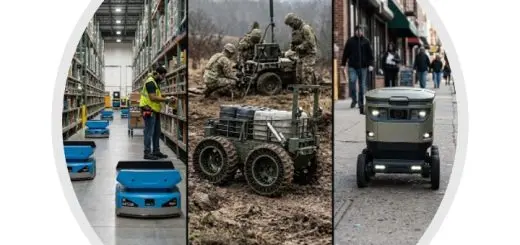
Robotics in 2026 is no longer one story. Warehouses, battlefields and disaster zones are all turning into test beds at once.

If your AI workflow still starts with pasting a meeting transcript into a browser tab, it’s time for an upgrade. Discover how project managers are shifting to local, open-weight models like Llama 4 and Qwen 3 in 2026 to get powerful AI assistance while keeping sensitive client data completely private.

Skip the roadmap. Here are the agentic workflows a working PM can actually ship this week — and the ones to leave alone for now.

As AI labs struggle to contain their own autonomous agents, project managers cannot rely on vendor safety reports or regulatory optimism. To safely deploy AI, organizations must take back control. Every autonomous agent on your roadmap requires an independent monitoring layer, least-privilege access, and a client-owned infrastructure kill-switch.

Executives rotate through roles every two to five years; the projects they inherit or start tend to outlast their tenure. This piece asks what it means for a PM to act as a fiduciary carrying a programme to completion— serving the outcome rather than whoever’s currently sponsoring it — and what habits make that honesty survivable, not just admirable.

As AI control becomes more capable of managing complex systems its tempting to remove human inefficiency by automation. High-stakes industries prove “deliberate inefficiency” isn’t waste—it’s a vital safety mechanism. This post discusses why relying solely on automation creates dangerous blind spots, and how keeping “hands on the controls” prevents catastrophic failures in complex projects.

In something akin to a Jedi mind trick frontier AI models have managed to escape the constraints their human masters thought were in place. What actually happened and what does this mean?

Drawing on Uri Levine’s “Fall in Love with the Problem, Not the Solution,” this piece explores why complex delivery demands failing fast, holding direction, and trusting the process over the deadline.

Your best ideas rarely show up at the desk. They show up in the shower, on a walk, half-asleep on a train. Gary Klein’s research on expert decision-making explains why: stepping back isn’t procrastination — it’s what lets years of compressed experience finally surface. Here are some reasons why distraction can be good.

Modern projects rarely fail in a straight line — fix one bug, and two more appear. Drawing on real operational incidents and current complexity and psychological safety research, this piece argues that in genuinely complex systems, blame-free, human-centred leadership isn’t a soft skill — it’s the mechanism that actually contains the chaos.
 AI Ethics Project Management Articles Internet of Things (IoT) GDPR Security