The B Game: Why Your Best Ideas Happen When You Stop Trying
When did you last solve a genuinely hard problem by staring at it harder?
Be honest. For most of us, the real breakthrough didn’t happen in the meeting, or at the desk, or in the fourth hour of a workshop. It happened in the shower. On a walk. Half-asleep on a train. Somewhere in the gap between “I’ve got nothing” and “wait — what if we…”
If that’s true for you, it isn’t a character flaw, it’s the art of distraction. It’s how high-performing minds are built to work. And it raises an uncomfortable question for anyone who’s spent a career always ’trying’ to bring their A game. What if the A game isn’t always the answer? What if deliberately dropping into a B game — distracted, unfocused, half-elsewhere — is actually part of the process?

The science of stepping away
Psychologists call it the incubation effect: problems get solved better after you put them down than if you’d kept grinding. It’s not a new idea — it dates back nearly a century — but the mechanism behind it has become much clearer. A well-known 2012 study published in Psychological Science found that letting the mind wander on an undemanding task actually boosted people’s ability to solve creative problems afterwards, more than resting quietly or working straight through. The researchers called their paper, fittingly, “Inspired by Distraction.”
Why would drifting off help? Neuroscience points to something called the default mode network — the set of brain regions that switches on precisely when you stop concentrating on the outside world. It’s active when you’re daydreaming, remembering, imagining what’s next. Studies using brain scans have found that people who score highly on creativity tests tend to show stronger connectivity in this network. It seems to work by quietly cross-wiring ideas and memories that your focused, task-driven brain would never think to connect.
Take James Dyson’s cyclone vaccum cleaner. It took him over five thousand prototypes trying to solve one specific, maddening problem: vacuum bags clog with dust, and a clogged bag loses suction, and no amount of re-engineering the bag itself seemed to fix that. The breakthrough didn’t come from staring harder at the bag. It came on a visit to a local sawmill, watching a industrial cyclone tower spin sawdust out of the air with no filter at all — a machine designed to solve someone else’s problem entirely, that he wasn’t there to study. His attention was elsewhere, and that’s precisely what let the two problems — sawdust in air, dust in suction — collide in a way five thousand focused prototypes hadn’t produced. The idea wasn’t waiting at the sawmill for him to find it. It was waiting in the gap between his expertise and his distraction, and it needed both to show up.
So it’s worth considering that some things which feel like a waste of productive time — going for a walk, or catching up with a colleague about something outside of work — might be the best thing you could do. That means building unstructured downtime into a working day, not as a reward for finishing, but as part of how the work gets done.
Next time you get stuck why not consider some lateral thinking puzzles are a great way to stimulate the mind and unlocking creativity, here are some examples.
Intuition isn’t guesswork — it’s compressed experience
There’s a separate, related idea worth unpacking, because “distraction helps” can sound like an excuse to disengage. It isn’t. The professionals who benefit most from stepping back are usually the ones who’ve put in the hours first.
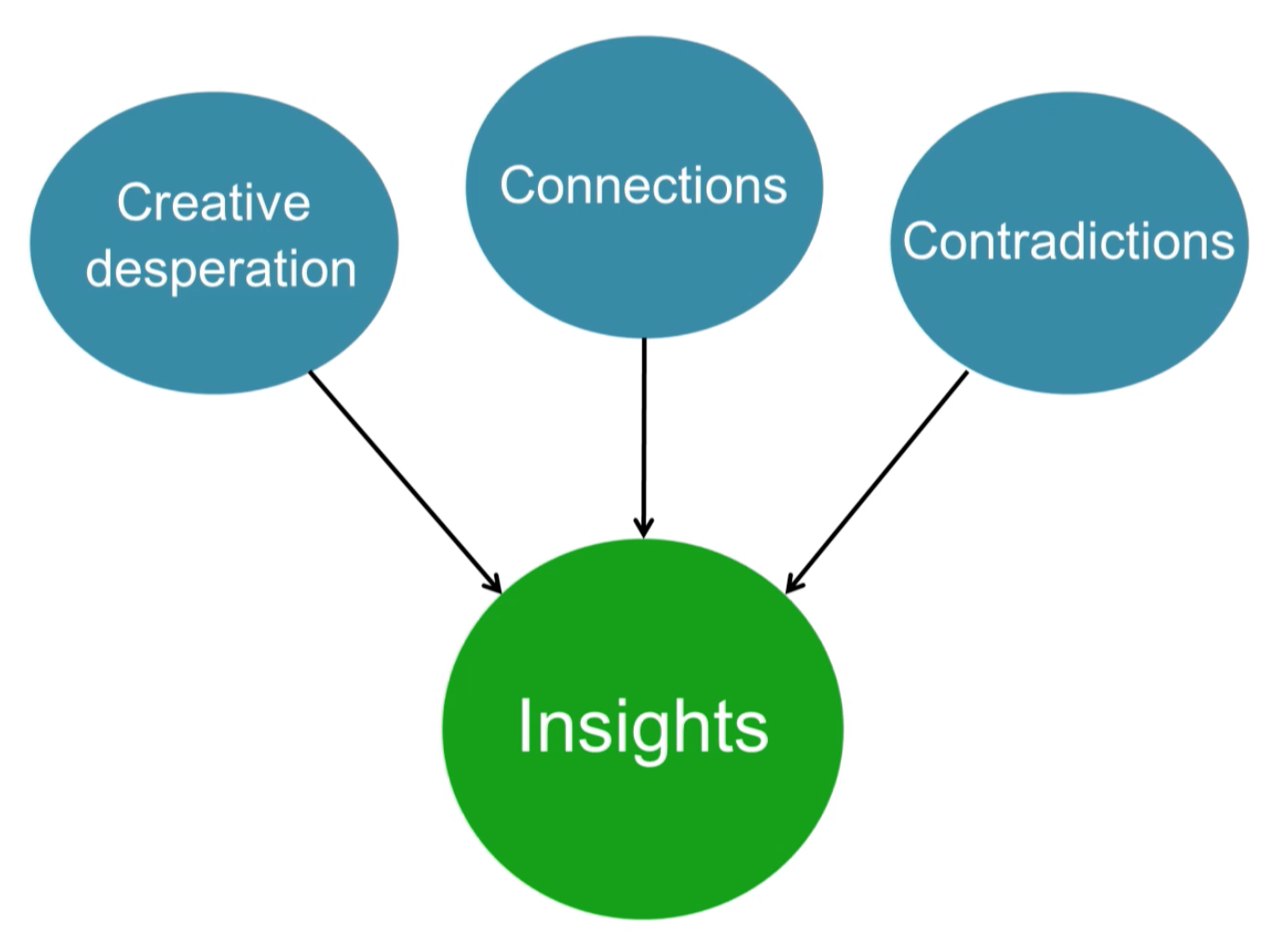
Do you trust your own instinct on the problems you know best? Gary Klein spent decades studying how firefighters, pilots, and emergency clinicians make high-stakes calls in seconds, often without being able to explain why. He found insight tends to arrive by one of three routes — creative desperation, connections drawn from experience, or spotting a contradiction that exposes the real problem — and the common thread across the high performers who made good decisions under pressure was an open, curious mind.
His most influential finding, the Recognition-Primed Decision model, gets at why. Experienced professionals aren’t running formal analysis under pressure — they’re pattern-matching against thousands of prior situations, and the “right” answer simply surfaces. What looks like a hunch is really years of experience, compressed.
Here’s the obvious objection, though: doesn’t “step away from the problem” just sound like a sophisticated excuse to avoid the deadline? It’s a fair challenge — and the answer is that incubation only works on the back of that compressed experience. Daydreaming on a problem you know nothing about produces nothing. Daydreaming on a problem you’ve been steeped in for years — one where your pattern library is deep — is when the disconnected walk turns into the “wait, what if” moment. The distraction doesn’t replace expertise. It’s what lets expertise finish its sentence. Which also means this isn’t a licence to disengage from problems you haven’t earned the instincts for yet — incubation is a multiplier on expertise, not a substitute for it.
Why delaying problem solving can be good
- You get better information
- Initial information is often incomplete.
- Waiting can reveal facts, dependencies and constraints that change the solution.
- “More information can turn the wrong problem into the right problem.”
- It separates urgency from importance
- A problem that feels urgent isn’t necessarily important.
- Taking time allows you to ask: What happens if we do nothing for 24 hours?
- Sometimes the problem resolves itself—or becomes much smaller.
- You avoid solving the wrong problem
- One of the biggest project-management mistakes is jumping straight to solutions.
- Pause and ask “Why is this happening?” five times before deciding what to do.
- Your brain needs time to process complexity
- Stepping away allows unconscious thinking to connect information that isn’t obvious when you’re intensely focused.
- This is why solutions sometimes appear while walking, driving or doing something unrelated.
- You reduce emotional decision-making
- Problems often arrive with pressure, blame and anxiety.
- A short pause creates distance between emotion and action.
- Good leaders don’t necessarily respond fastest; they respond best.
- You create space for other people to solve it
- If a leader immediately provides the answer, the team becomes dependent on the leader.
- Waiting can encourage someone closer to the problem to develop a better solution.
- You discover whether the problem is temporary
- Some problems are symptoms rather than root causes.
- Changing something too quickly can actually make things worse.
- You increase the quality of decisions
- A rushed decision optimises for speed.
- A considered decision can optimise for outcome, sustainability and risk.
- You can see the bigger system
- In complex organisations, fixing one issue can create another elsewhere.
- Waiting gives you time to consider the wider consequences.
- You learn more from the problem
- Sometimes the most valuable question isn’t “How do we fix this?”
- It’s “What is this problem trying to tell us?
None of this requires unstructured time off; it requires treating the gap between naming a problem and solving it as part of the work, not dead time before the real work starts.
Let Your B Game Solve the Problem
This isn’t about carving out retreats or “team days.” It’s about noticing that the walk to get coffee, the commute, the dog walk, the conversation with a colleague about something unrelated — these aren’t breaks from the problem. For anyone whose pattern library is already deep, they’re often where the problem actually gets solved.
So, one question worth answering rather than skimming past: this week, where will you deliberately let your B game show up — and what problem might finally get solved because of it?