
Stop Trying to Fix Everything: The Smarter Way to Deliver Digital Projects
In the world of digital project management, it’s a familiar narrative: a project kicks off with high hopes and a clear vision, only to become bogged down by delays, budget overruns, and creeping scope. With a significant percentage of digital initiatives failing to meet their original goals, it’s evident that traditional project management approaches are struggling to keep pace. The challenge is only set to intensify. As we look towards 2025, the landscape of web development is being reshaped by powerful forces like AI-driven development, hyper-personalisation, sustainable web design, and the nascent metaverse.
The answer may lie not in a novel, unproven methodology, but in the timeless wisdom of a framework developed for manufacturing floors: the Theory of Constraints (TOC). This powerful philosophy is often overlooked inthe software world, yet it provides a laser-focused approach to managing complex systems. By applying the five focusing steps of TOC, development teams can systematically identify and eliminate **digital project bottlenecks**, enabling them to not only survive but thrive in the fast-paced digital landscape of 2025. This is about building a resilient workflow for the future of web development.
What is the Theory of Constraints (TOC)? A Quick Refresher
Developed by Dr. Eliyahu M. Goldratt and famously illustrated in his book “The Goal,” the Theory of Constraints is built on a simple yet profound observation: every complex system, at any given time, has at least one constraint that limits its performance. In essence, your entire project’s speed is dictated by its lowest part. The goal of TOC is not to eliminate all problems at once, but to focus all improvement efforts on that single, most impactful constraint.
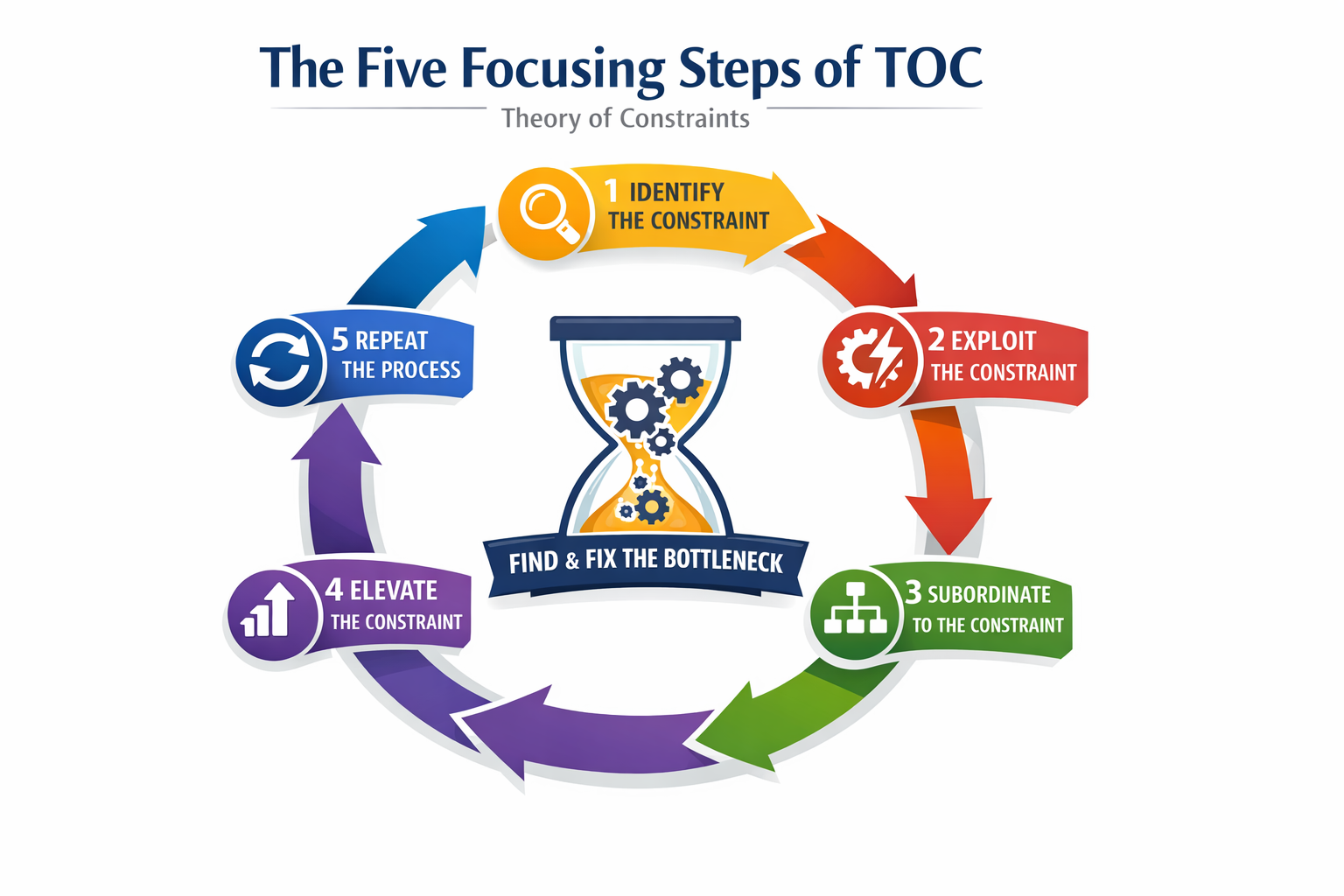
The methodology for achieving this is an elegant and iterative process known as the Five Focusing Steps. This process provides a clear roadmap for optimising your web development workflow.
- Identify the system’s constraint. This is the single part of the process that limits the throughput of the entire system.
- Exploit the system’s constraint. Maximise the productivity of the constraint using the resources you already have. Ensure it is only working on what is most important and is never idle.
- Subordinate everything else to the above decision. The rest of the system must support the constraint. This means other parts of the process might slow down to ensure the constraint is never starved for work or overwhelmed.
- Elevate the system’s constraint. If the constraint still limits the system after being fully exploited, invest in improving it. This could mean more training, better tools, or additional resources.
- Repeat the process. Once a constraint is broken, a new one will emerge. The cycle of continuous improvement begins again.
Identifying the Constraints in 2025’s Digital Web Projects
In the past, a constraint in web development might have been a slow server, a cumbersome deployment process, or a single developer with specialised knowledge. While those still exist, the nature of web project management in 2025 introduces far more nuanced and complex constraints. The bottlenecks of the future are less about individual components and more about intricate, interconnected processes that demand a new level of strategic oversight.
Here are some of the potential constraints we anticipate will define Theory of Constraints digital projects in the coming years:
- The AI Integration Bottleneck: The promise of AI in web development is immense, but integrating, training, and validating complex machine learning models for personalisation or automation can become a massive time sink, holding back the entire development pipeline.
- The Sustainable Code Challenge: As environmental impact becomes a critical metric, the need for sustainable web design will grow. The constraint here is the specialised knowledge and time required to optimise code for energy efficiency and a minimal carbon footprint.
- The Data Privacy and Security Hurdle: With ever-stricter regulations, ensuring robust data privacy and security is non-negotiable. The required legal and technical reviews can become a significant bottleneck, especially for projects dealing with sensitive user data.
- The User Experience (UX) Research Gap: Creating truly hyper-personalised experiences requires deep, continuous user research. The constraint is often the team’s capacity to gather, synthesise, and act upon vast amounts of user data in a timely manner.
- The Talent and Skills Shortage: The rapid evolution of technology means there is a constant shortage of developers with cutting-edge skills. Finding and retaining talent with expertise in emerging areas can be the single biggest factor limiting a project’s progress.
Applying the Five Steps: A 2025 Web Project Case Study
To illustrate this in practice, let’s consider a fictional team, “FutureCart,” tasked with building a highly personalised, AI-powered e-commerce platform in 2025. They are falling behind schedule, and team morale is low. They decide to apply TOC for web development to diagnose and solve their issues.
First, the FutureCart team maps their entire workflow and identifies their primary constraint: the slow, manual process of QA testing and validating the AI’s recommendation engine. Everything grinds to a halt waiting for QA to confirm the recommendations are accurate. To exploit this constraint, they create a dedicated “AI testing sprint” and provide the QA team with better data visualisation tools, ensuring they work only on the highest-priority validation tasks. Next, they subordinate the rest of the process; development and data science teams now pace their work to the QA team’s capacity, preventing the testers from being overwhelmed.
After these steps, testing is still the bottleneck, so the team moves to elevate the constraint. With a clear, data-backed justification, management approves the purchase of an automated AI testing platform and invests in training. This significantly increases the capacity of the former bottleneck. Finally, the team prepares to repeat the process. With testing resolved, they re-evaluate and discover a new constraint in the content creation pipeline, which can’t produce personalised descriptions fast enough to feed the AI. The cycle of continuous improvement begins again.
The Future is Bright: TOC as a Competitive Advantage
Adopting the Theory of Constraints is about more than just clearing a single backlog; it is a fundamental shift towards a culture of continuous improvement. When teams learn to see their work as a system and to identify the one thing holding it back, they move from a reactive state to a proactive one. This approach fosters resilience, empowering teams to adapt to the inevitable changes and challenges that define the
Future of web development.
Furthermore, TOC does not replace methodologies like Agile project management or DevOps; it enhances them. Agile sprints can be structured around exploiting a constraint, and DevOps pipelines can be optimised to elevate it. TOC provides the “why” behind the “what” of your improvement efforts, ensuring that your team’s energy is always focused where it will have the greatest impact. This synergy is what makes TOC a vital component of the most effective project management trends for 2025.
Your First Step to Constraint-Free Development
The digital landscape of 2025 will be defined by complexity, but your projects do not have to be defined by chaos. The Theory of Constraints offers a proven, logical path to clarity and efficiency. By understanding that your project’s success is dictated by its weakest link, you can stop trying to optimise everything at once and start making targeted, high-impact improvements. This focused approach is the key to delivering exceptional digital experiences on time and on budget.
Ready to find your bottleneck? Start by mapping your process from idea to deployment. Gather your team and be honest about where work piles up and communication breaks down. That is your starting point.
Share this article with your team and start a conversation about how you can apply the Theory of Constraints to your own workflows.
We will leave you with a question: What is the biggest bottleneck holding your team back right now?