
Stop Calling It a Failure.
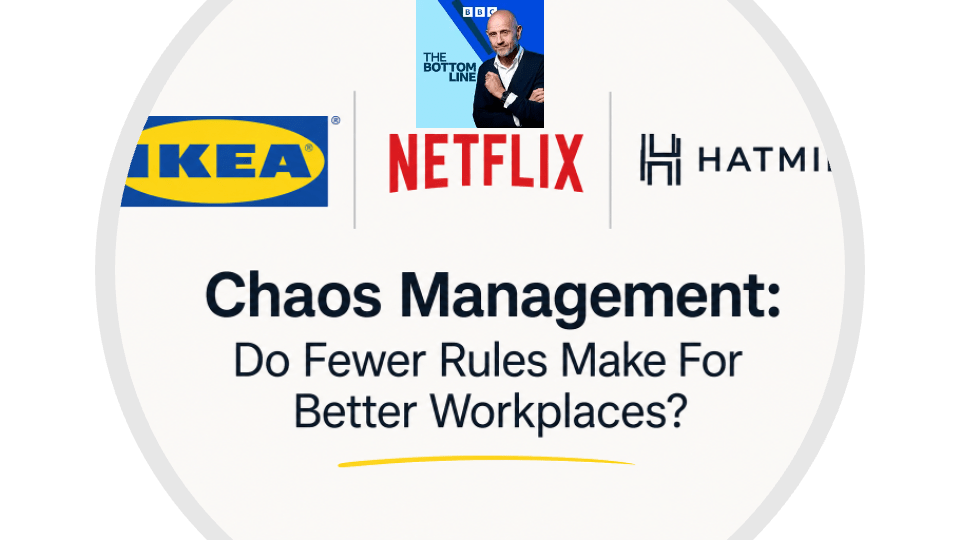
It Might Be Your Most Valuable Asset. I was listening to the Bottom Line BBC podcast where some business leaders were discussing chaos management. What resonated with me, is how often senior management might consider a project delay or pilot failure as a mistake. But it’s not a mistake. Any project has a degree of risk and sometimes those risks go the wrong way.
Here’s the problem: it’s easy to confuse two very different things. A failure is a systemic breakdown — poor planning, ignored risks, a delivery that should never have happened. A mistake is what happens when a capable person tries something new, reads the situation differently, and it doesn’t land the way they hoped.
It got me thinking about a distinction we rarely make clearly enough. Treating them the same disincentivises your best people from taking risks and trying new ideas.
The Industrial Hangover
Most of the governance frameworks we operate inside were designed for a different era. An era where the primary risk was inconsistency. Where the goal was to eliminate variance, replicate output, and keep every cog turning the same way.
That model made sense when you were manufacturing widgets at scale. It makes far less sense when you’re trying to deliver digital transformation programmes in organisations that didn’t exist a decade ago.
The bureaucracy we inherited — the approval chains, the job descriptions, the sign-off matrices — is largely a hangover from that industrial period. It was built to prevent error. And it does. But it also prevents something else: the kind of fresh thinking that keeps organisations relevant.
In a safety-critical environment — construction, medical, aerospace — that trade-off is correct. You want an orchestra, not a jazz band. Every note matters. The conductor controls everything.
But most of us aren’t working in that environment. And we’re still using the same playbook.
When Structure Becomes the Risk
Start with a thought experiment: in the last six months, how many good ideas died quietly in your organisation before anyone ever tested them?
Not because they were bad ideas. Because someone looked at the approval process and decided it wasn’t worth the effort. Or because the person who had the idea was junior, and the path to getting it heard was too steep. Or because the last person who tried something different got made an example of.
That’s not risk management. That’s risk disguised as governance.
The greatest risk in innovation-driven delivery isn’t making a mistake. It’s becoming irrelevant because nobody was allowed to try anything different.
The Pilot That Didn’t Deliver — And Why That’s Not a Failure
Here’s a scenario most senior PMs will recognise.
A team identifies an opportunity. They make the case, get the green light, and run a pilot. Six weeks later, the results don’t match the hypothesis. Engagement is lower than projected. The numbers don’t stack up. Leadership reviews the output and the word failure enters the room.
The team who ran it — the ones who designed it carefully, gathered the data, iterated where they could — watch it get labelled the same way a collapsed programme or a missed go-live gets labelled.
And something quietly breaks.
Because that pilot wasn’t a failure. It was a structured attempt to test an idea in conditions that hadn’t been tested before. It produced real data. It eliminated a direction that looked promising but wasn’t. It told the organisation something it genuinely needed to know.
That’s not failure. That’s science.
The problem is that when we treat honest attempts as mistakes, we don’t just damage one project. We damage the willingness of every capable person in the room to stick their neck out next time. Confidence erodes — not in the idea, but in the safety of having ideas at all. And in organisations that need to move fast and try things, that erosion is far more costly than any failed pilot.
The right response isn’t a lessons learned document filed in SharePoint. It’s a genuine, visible signal from leadership that trying was the right call — and that the learning is the deliverable.
Creating the Conditions for Courage
Some organisations have already worked this out.
Netflix tore up their travel and vacation policies. Not because expenses don’t matter, but because the signal it sent — we trust you to make good decisions — was worth more than the policy itself. They called it Talent Density. High performers don’t need to be controlled. They need context.
Hatmill, the supply chain consultancy, went further. No job titles. No job descriptions. No formal hierarchy. Employees are expected to read the organisation — to observe where the need is and move toward it. They call it listening to the river.
IKEA’s outgoing CEO created what he called Banana Cards — physical tokens he co-signed with employees to pre-authorise attempts. The message was simple: here’s your permission slip to try something fragile. If it doesn’t work, I’ve already signed off on it. Go.
Think about what that does to the culture of a room. It separates the act of trying from the fear of consequence. It makes innovation feel safe without removing accountability.
As project managers, we have more power to create that environment than we often realise. We set the tone in the retrospective. We decide whether a risk that materialised becomes a learning or a liability. We choose whether “it didn’t work” gets treated as data or as evidence of incompetence.
AI Is the Biggest Pilot Opportunity You Have Right Now
There has never been a better moment to build a culture that celebrates the attempt.
AI is creating genuine opportunities to rethink how project teams work — how we surface risk, how we communicate with stakeholders, how we automate the low-value administrative weight that drains senior PMs. These aren’t theoretical possibilities. Teams are already using AI to draft status reports, interrogate project data, model scenarios, and identify patterns in delivery that would take a human analyst days to find.
But almost none of this happens through a formal programme or a sanctioned transformation roadmap. It happens through someone trying something. Running a small pilot. Seeing what works.
The irony is that AI — arguably the most disruptive tool available to project teams right now — is best explored through exactly the kind of informal, iterative experimentation that rigid governance structures tend to kill.
If your organisation treats every inconclusive pilot as a failure, you will not successfully adopt AI. You will watch the organisations around you move faster, deliver more, and compete on a different level — while your teams are still waiting for sign-off to try a prompt template.
The teams that will get this right are the ones led by project managers who create psychological safety around the attempt. Who say: we’re going to try things, some won’t work, and that’s the point. Who treat the first iteration not as the final word, but as the first data point.
Managed Chaos Isn’t the Absence of Structure
This isn’t an argument for anarchy. Chaos without conditions is just dysfunction with better branding.
The organisations that operate well on the edge of chaos share three things:
Talent density. Empowerment only works with the right people. If you’re building a team of high performers and treating them like they need a handbook for every decision, you’re the bottleneck.
Shared purpose. In the absence of a rulebook, something else has to guide decision-making. The best teams operate from a clear understanding of what the organisation is trying to achieve and why. Not rules — values with enough clarity to act on.
The Advice Process. At Hatmill, anyone can make any decision. The one condition: you first consult with people who have expertise in the matter, and those who will be affected by the outcome. You don’t need permission. But you do need perspective.
That last one is particularly powerful in project environments. It removes the bottleneck of hierarchical approval while still embedding collective intelligence into individual decisions.
An Idea to Try
The next time a pilot doesn’t deliver what you hoped, before you reach for the language of failure, ask a better question: did this team try something deliberately, gather learning, and come back smarter?
If yes, that’s not a failure. That’s exactly what good looks like.
Your job as a senior PM isn’t to prevent the attempt. It’s to create the conditions where attempting is safe — and where the learning that follows is treated as an asset, not an embarrassment.
Structure should be the scaffolding that makes ambition possible. When it becomes the ceiling, you have a leadership problem — not a governance one.
The organisations outpacing you right now aren’t doing it by eliminating risk. They’re doing it by trying faster, learning quicker, and giving their best people room to move.
In a world where AI is reshaping what’s possible in delivery, that capability — the willingness to run the pilot, learn from the result, and go again — is the competitive advantage that no tool can give you.
Only culture can.