Dragon Slayer: Leading Through the Hydra of Complex Systems
Every Project manager working in modern technology knows the feeling. You fix one bug, and two more appear in its place. You close one risk, and the mitigation itself creates a new one. It starts to feel less like a Project Plan and more like a myth — you’re fighting a Hydra, and every head you cut off grows back doubled.
Here is a recent example: a label format improvement required a printer firmware upgrade, which triggered a network conflict, which had two printers printing the same label — operational chaos, in the coffee shop in real time. Or: a tax rule change needed a fiscal update, which needed a POS software update, which introduced new bugs of its own, which cost real sales. In both cases, the fix wasn’t technical alone — it took operations, product, and vendors in the same room, having difficult conversations, with everyone asking why it couldn’t be resolved faster and a sales loss nobody wanted to accept even short-term. That pressure lands squarely on the people in the middle — operations and project managers — absorbing the uncertainty, the urgency, and the complexity all at once.
What actually got both of these resolved wasn’t a faster patch. It was the moment everyone stopped asking “whose fault is this” and started asking “what is this system actually doing.” Once blame left the table, the vendor, ops, and product could name the real interaction causing the failure — and fix it once, properly, instead of layering another quick patch on top that would only grow a third head.

It’s tempting to treat that as a joke about bad code or under-resourced teams. It isn’t. It’s a fairly precise description of a complex system, and it turns out the research has quite a lot to say about how project and operations managers should respond to it — and why the human side of the job matters more, not less, when the technology gets harder to control.
Why the Hydra Keeps Growing Heads
Project complexity researchers describe complex projects as defined by ambiguity, interdependency, non-linearity, emergent behaviour, and unfixed boundaries — in other words, the pieces interact in ways that can’t be fully mapped in advance, so fixes in one place ripple out and create new problems elsewhere. This isn’t a failure of planning. It’s the nature of the system.
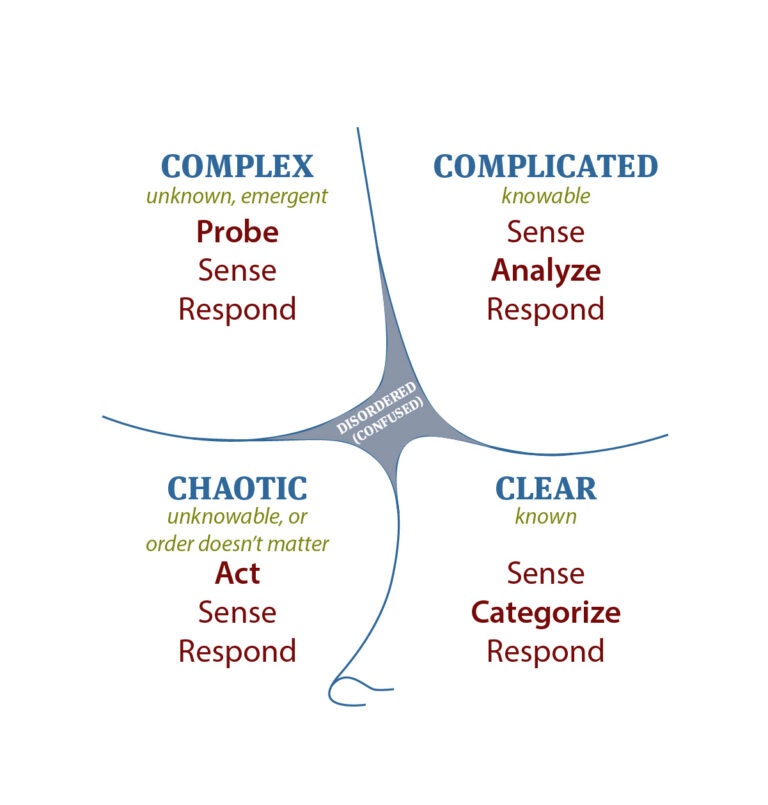
The Cynefin framework (pronounced kuh-nev-in), widely used in project complexity research, draws a sharp distinction here. In a complicated system, cause and effect are knowable in advance if you bring in the right expert. In a complex system, cause and effect can only be understood in retrospect — something happens, it affects the project, and only afterwards can you trace why. That’s the Hydra. You genuinely cannot predict which head will grow next, and pretending otherwise — forcing rigid, linear plans onto a non-linear system — is what turns a manageable fight into a losing one.
This is also the academic home of “unknown unknowns”: challenges that don’t exist as risks on any register because nobody could have known to look for them, often triggered by the sheer density of interactions in a complex technical environment. The more integrated and interdependent your systems, the more of these you should expect — not as a sign something has gone wrong, but as the baseline cost of doing complex work at all.
The Data on Fighting It Together
Here’s where it gets interesting for how we lead, not just how we plan. If a system is genuinely complex, then rigid command-and-control planning cannot out-think it — but research suggests something else can help teams absorb the shock: psychological safety.
A 2024 CIPD evidence review found that while conflict tends to lower psychological safety in the moment, teams that are well managed work through those challenges over time and come out stronger — the strain doesn’t have to be corrosive if it’s handled well. In software and agile project settings specifically, recent research (Barros et al., 2024) identified psychological safety as a significant indirect success factor for agile development projects. And it’s not just correlation dressed up as insight: psychologically safe teams are measurably better at the specific behaviours a Hydra-fight demands — speaking up early about a problem, questioning an assumption before it becomes a costly mistake, and admitting an error fast enough to contain it rather than letting it compound.
Put simply: the technology will keep generating unknowns no matter how good your plan is. What determines whether your team survives that is whether people feel safe enough to surface the second head the moment it appears, instead of quietly hoping it goes away.
Fighting the Hydra Well
None of this means abandoning rigour — it means aiming it at the right target. A few practical shifts follow directly from the research:
- Separate the system from the person. When a fix spawns a new bug, investigate the interaction of components, not the competence of the engineer or vendor who touched them. Complexity research is explicit that this kind of emergent failure is a property of the system, not a verdict on the individual.
- Plan for the unknown unknowns, don’t just react to them. Build in slack — time, budget, attention — specifically for the discoveries you can’t yet name. Treating every surprise as a schedule failure guarantees people start hiding surprises instead of raising them.
- Make it safe to say “I think this broke something.” The single biggest lever the research points to is speed of disclosure. A team that surfaces the second head in hours contains it; a team that hides it for fear of blame lets it multiply. That sometimes means defending a short-term sales loss to protect a proper fix — a real cost, but a smaller one than the compounding cost of a rushed patch that spawns a third head next month.
- Focus the team on one head at a time. Complex systems overwhelm attention as much as capacity. Naming a single, specific problem to solve — rather than the full list of twenty open issues — is what allows a team to actually finish something.
- Check in on people, not just the plan. Fatigue and frustration are leading indicators of a team that’s about to stop reporting problems early. A five-minute human check-in is cheap risk mitigation.
The Real Job
The Hydra was never meant to be killed. In the myth, Hercules doesn’t win by out-swinging the monster — he wins by changing the fight, cauterising each wound so a new head can’t take root. That’s a fair metaphor for what good project leadership does in a complex technical environment: not eliminating uncertainty, but building a team resilient and honest enough that each new head gets spotted, named, and dealt with before it multiplies.
The technology will keep throwing up problems we didn’t plan for. That’s not a sign the project is going badly — it’s a sign the project is genuinely complex. The variable we actually control is whether our people feel safe enough to fight it together.