
RAG is the New Sexy: Why 2024 is the Year of Retrieval-Augmented Generation
A deep dive into the what, why, and how of RAG, and why it’s the most important trend in AI right now.
Have you ever asked a chatbot for a fact and received a beautifully written, grammatically perfect, and completely fabricated answer? You’re not alone. This phenomenon, known as “hallucination,” is one of the most significant challenges in the world of Generative AI. The core issue is that Large Language Models (LLMs), for all their incredible power, are essentially frozen in time. Their knowledge is limited to the data they were trained on, and they lack a direct connection to real-time, verifiable information. This can lead them to confidently make things up, cite non-existent sources, or provide outdated details.
This is where Retrieval-Augmented Generation (RAG) comes in. RAG isn’t just another acronym in the ever-expanding lexicon of AI; it’s an elegant and practical solution that bridges the gap between the creative potential of LLMs and the real world’s demand for accuracy. It’s the technology that’s turning chatbots into reliable assistants and making AI applications more trustworthy and powerful than ever before. This article will explore the latest AI Trends in 2024 surrounding RAG, its key players, and how you can get started with this transformative approach to AI development.
What is RAG and Why Does it Matter?
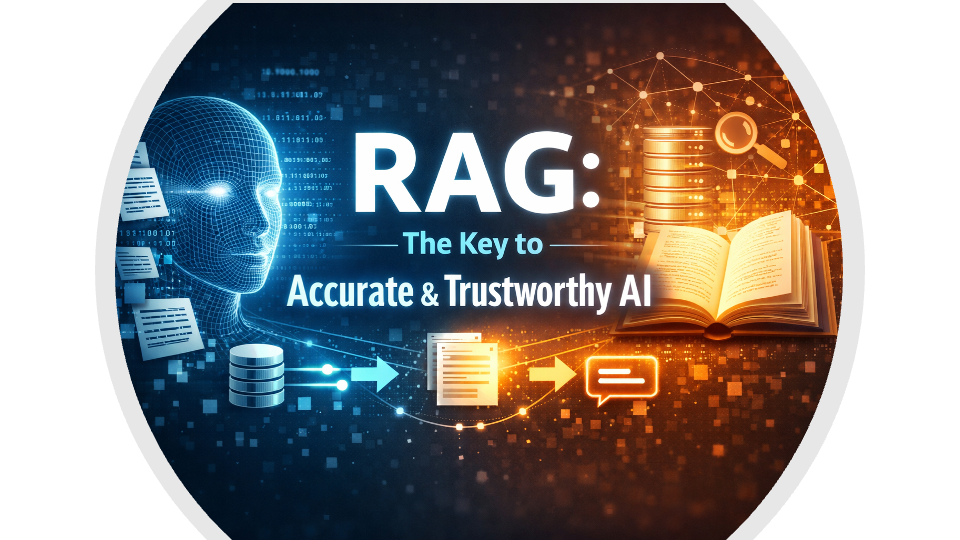
The easiest way to understand Retrieval-Augmented Generation is through the “open-book exam” analogy. Imagine an LLM is a brilliant, eloquent student taking a test. Without RAG, it’s a closed-book exam; the student must rely solely on what they’ve memorized. They might know a lot, but their knowledge has gaps and can be outdated. With RAG, it becomes an open-book exam. Before answering a question, the student can consult a curated library of approved textbooks and notes—your data. This allows them to provide answers that are not only well-written but also factually grounded in a specific, reliable source of information.
The technical process is just as elegant. When a user submits a query, the RAG system first retrieves relevant snippets of information from a pre-defined knowledge base, such as company documents or a database of recent articles. This retrieval step is powered by converting the knowledge base into numerical representations called vector embeddings, allowing the system to find documents based on semantic meaning, not just keywords. Next, it augments the user’s original prompt by adding this retrieved context. Finally, the enhanced prompt is fed to the LLM, which generates a comprehensive answer based on both the original question and the provided factual data.
The benefits of this approach are immediate and profound. Firstly, it drastically reduces LLM hallucinations by grounding the model’s responses in verifiable data, leading to a massive improvement in accuracy and relevance. Secondly, RAG allows businesses to securely connect LLMs to their private, domain-specific knowledge, creating expert chatbots for customer service or internal data analysis without having to retrain a massive model from scratch. Finally, because the system knows exactly which documents it used to form an answer, it can provide citations and sources, fostering a new level of trust and transparency in AI.
Top RAG Trends in 2024
It’s no exaggeration to say that 2024 is “The Year of RAG.” The concept has moved from a niche academic idea to the forefront of practical AI development. The most exciting developments aren’t just about using RAG, but about making it smarter, more flexible, and more powerful. We’re seeing a shift from simple, monolithic RAG pipelines to more sophisticated architectures that are pushing the boundaries of what’s possible.
One of the most significant trends is the rise of Modular RAG. Instead of a rigid, one-size-fits-all pipeline, developers now think of RAG as a series of interchangeable components. You can swap out different retrieval models, re-ranking strategies, and generation models to optimize for specific tasks. This flexibility allows for fine-tuning the system for speed, accuracy, or cost. Another cutting-edge approach gaining traction is Graph-Based RAG, which uses knowledge graphs instead of simple document chunks. This allows the system to understand the relationships between entities, enabling it to answer more complex queries like, “Which customers who bought Product A also reported issues with Product B in the last month?”
Looking further ahead, the most exciting evolution is Agentic RAG. This involves creating autonomous AI “agents” that can reason about a user’s query and proactively decide when, where, and how to retrieve information. An agent might decide a query requires searching multiple databases, calling an API for real-time data, and then synthesizing all of that information before generating a final answer. This represents a significant leap towards more dynamic and intelligent AI systems, moving from simple Q&A to complex, multi-step problem-solving.
Key Players and Tools in the RAG Ecosystem
The explosion of interest in RAG has led to the rapid growth of a vibrant ecosystem of tools and platforms designed to make implementation easier. For developers looking to get their hands dirty, a few names have become indispensable. Frameworks like LangChain and LlamaIndex are the clear leaders, providing the open-source building blocks and abstractions needed to connect LLMs with custom data sources and construct robust RAG pipelines.
At the heart of any RAG system is a vector database. These specialized databases are designed to store and efficiently query vector embeddings—the numerical representations of your data. Players like Pinecone, Weaviate, and Chroma have become essential infrastructure for any serious RAG project, enabling the lightning-fast similarity searches required to find relevant information in massive datasets.
The major cloud providers have also taken notice. Amazon Bedrock, Google Vertex AI, and Microsoft Azure AI are all heavily investing in integrating managed RAG capabilities into their platforms. They offer end-to-end solutions that simplify the process of setting up knowledge bases, managing embeddings, and deploying RAG-powered applications, making this powerful technology more accessible to enterprises of all sizes.
Getting Started with RAG: A Simple Roadmap
Diving into Retrieval-Augmented Generation might seem daunting, but the modern toolset has made it more approachable than ever. For those looking to build their first RAG application, here is a high-level roadmap to guide you through the process. Think of this as your starter kit for building more factual and reliable Generative AI.
The journey from concept to a working RAG application involves a few key steps:
- Choose your LLM: Select the language model that will serve as the “brain” of your operation. You can use a powerful proprietary model from providers like OpenAI or Cohere, or opt for an open-source model like Llama or Mistral for more control.
- Prepare your Knowledge Base: This is your “open book.” Gather the documents, web pages, or database entries you want your AI to use as its source of truth. The quality of this data will directly impact the quality of your results.
- Select a Framework: Use a framework like LangChain or LlamaIndex to orchestrate the entire process. These tools provide pre-built components for loading data, creating embeddings, and managing the RAG chain.
- Set Up a Vector Database: Choose a vector database like Pinecone, Weaviate, or Chroma to store the vector embeddings of your knowledge base. This is the critical component that enables efficient retrieval.
- Build Your RAG Pipeline: Using your chosen framework, connect all the pieces: the data loader, the vector database, and the LLM. This pipeline will handle the full query-to-response workflow.
- Test and Iterate: Rigorously test your application. Ask it tough questions, check its sources, and identify where it struggles. Use these insights to iterate on your data, prompts, and pipeline configuration to continuously improve performance.
The Future of RAG
As we look towards 2025 and beyond, it’s clear that RAG is not just a fleeting trend but a foundational component of the Future of AI. Its importance will only grow as we demand more from our AI systems. We can expect to see much tighter integration of RAG with other AI technologies, leading to multi-modal systems that can retrieve and reason over text, images, and structured data simultaneously. Retrieval and generation techniques will become far more sophisticated, moving beyond simple keyword matching to a deeper semantic understanding of both the user’s query and the source material.
Ultimately, RAG is a critical step on the road to building more truthful, reliable, and trustworthy AI. By tethering the boundless creativity of LLMs to a verifiable source of facts, we mitigate the risks of misinformation and build systems that can be held accountable. This technology is paving the way for wider adoption of AI in high-stakes enterprise applications, from medical diagnosis and legal research to financial analysis, where accuracy isn’t just a feature—it’s a requirement.
Conclusion
The limitations of Large Language Models, particularly their tendency to hallucinate, have been a significant barrier to their adoption in mission-critical applications. Retrieval-Augmented Generation offers a powerful and practical solution, transforming LLMs from creative but sometimes unreliable storytellers into knowledgeable and fact-driven experts. By giving models an “open book” to consult, RAG enhances accuracy, enables customization with private data, and builds a foundation of trust through verifiable sources.
With the rapid evolution of trends like Modular, Graph-based, and Agentic RAG, and the support of a robust ecosystem of tools and platforms, 2024 is truly the year that RAG moves into the mainstream. From my perspective, it is one of the most important developments in the Generative AI landscape right now, unlocking a new frontier of reliable and intelligent AI applications.
What are your thoughts on RAG? Have you experimented with it? Share your experiences in the comments below!
Follow me for more deep dives into the latest AI trends.