What Do You See That Others Don’t?
Leadership in an Age of Disruption.
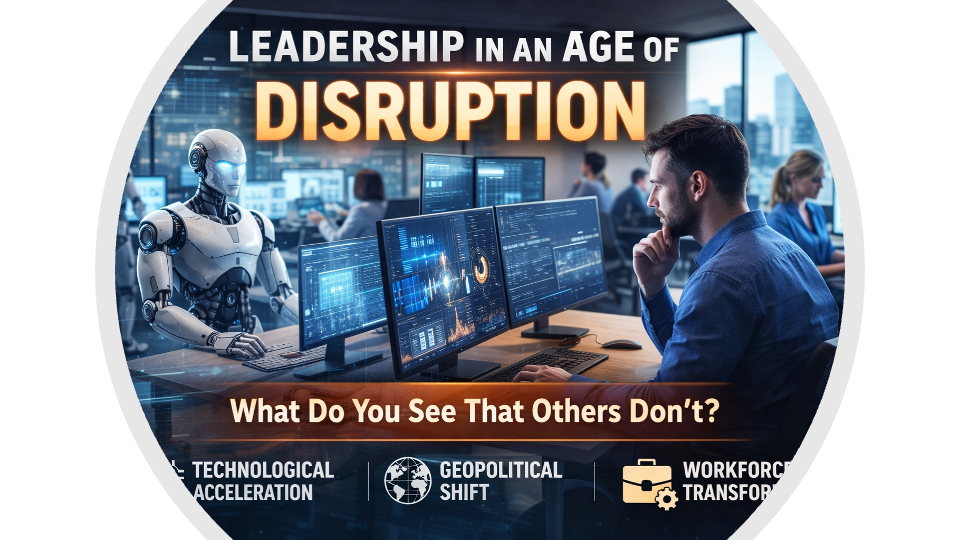
2025 was a year of breathtaking change. AI, robotics, and autonomous systems aren’t just future ideas—they’re already here reshaping work, industries, and even global security today. As we consider the possibilities of the new year, it’s good to reflect where we are and what the future holds.
As we enter 2026, we face three overlapping forces transforming the world:
- Rapid technological acceleration: We’re seeing the rapid rise of physical AI and autonomous systems — from embedded AI in robotics that operate in human environments to intelligent agents that perform real‐world tasks once thought exclusive to humans.
- Disruption of the geopolitical order: A shifting global order marked by rising international tensions, economic coercion, and lack of respect for international law. This is redefining how nations and organisations engage with one another.
- Restructuring of work: Work is being reshaped as AI and intelligent systems automate tasks, prompting organizations to rethink roles, redeploy talent, and focus humans on judgment, creativity, and oversight.
It’s easy to feel overwhelmed. The world feels more volatile, uncertain, complex, and ambiguous (VUCA) than ever. But disruption isn’t about reacting—it’s about asking better questions.
What fundamental truth do most people disagree with you on?
In Peter Thiel’s book zero to one, he asks the questions in interviews.
“What fundamental truth do most people disagree with you on?”
It’s a powerful question. It forces people to articulate what they believe that runs counter to conventional wisdom — what they see that others don’t.
It takes courage to challenge the status quo. But for Thiel, this willingness to think independently has been a defining strategy. Throughout his career, Thiel has disrupted stagnant industries by rejecting competition in favour of category creation — building long-term dominance rather than chasing short-term wins.
Thiel’s career illustrates this mindset:
- PayPal: Disrupted bank-controlled payments with peer-to-peer systems
- Palantir: Unified fragmented government and enterprise data
- SpaceX: Made reusable rockets a reality
- Founders Fund: Prioritized contrarian, long-term investments over short-term trends
In a world shifting rapidly from AI to physical AI and advanced robotics, this question feels more relevant than ever. These technologies are not speculative anymore — they are powering changes we’ve discussed for decades.
With the rise of agentic AI and large language models capable of performing many mid-level managerial tasks in narrow but meaningful domains, organisations are already restructuring. Roles once considered stable are being re-evaluated.
So how do we respond? How do we adapt when the ground keeps moving?
What is not going to change in the next ten years?
On the other side of disruption sits an equally valuable question — one Jeff Bezos is well known for asking:
Amazon’s success wasn’t built on predicting new desires, but on recognising enduring ones. People will never say, “I wish this was more expensive” or “I wish I had less choice.”
Bezos focused relentlessly on those constants — price, selection, and convenience — and built Amazon at scale around them, reshaping global commerce in the process (to the detriment of many local high streets).
Some enduring lessons from Bezos’ approach:
- Circumstances don’t define outcomes — responses do.
- Long-term success compounds through sustained effort.
- Big visions require the courage to think beyond yourself.
- Adversity is often the proving ground for innovation.
The common thread in disruption?
When you examine the leaders and companies that have reshaped entire industries, a pattern emerges.
They return to first principles.
- They question assumptions others accept.
- They build for decades, not quarters.
- They design systems, not just products.
Leaders like Peter Thiel, Jeff Bezos, Elon Musk, Sam Altman, Jensen Huang, Demis Hassabis, Jack Ma, and Satya Nadella show how thinking differently reshapes industries.
- Thiel challenged norms in fintech and data.
- Bezos built global commerce through long-term customer obsession.
- Musk reimagined energy and space with first-principles thinking.
- Altman scaled AI as infrastructure.
- Huang powered modern AI with GPUs.
- Hassabis accelerated scientific breakthroughs.
- Jack Ma built China’s e-commerce ecosystem.
- Nadella reinvented Microsoft for the cloud era.
It’s about how leaders think when certainty disappears.
Their common thread: question assumptions, think long-term, and design systems, not just products.
Conclusion
Each of us carries unique experience, insight, and perspective shaped by our own journeys. In times like these, progress doesn’t start with predicting the future — it starts with asking better questions.
Two are worth starting with:
- What fundamental truth do most people disagree with you on?
- What is not going to change in the next ten years?
If we can answer those honestly — and commit to developing our individual strengths — we may uncover something genuinely original. Something no one else has seen yet.
That’s how disruption happens.
Not through noise, but through clarity.
So as 2026 unfolds, the real question becomes:
What’s holding you back — and what would it look like to innovate for you?
- Which assumptions in your industry should you challenge today?
- How is AI reshaping your team, your roles, and your workflows?
- What constants can you build your strategy around, regardless of volatility?
The world is changing faster than ever—but clarity, curiosity, and bold thinking will always create opportunity.